Arduino Worm
Comments Off on Arduino Worm
http://youtu.be/3YnMUMJMp7A
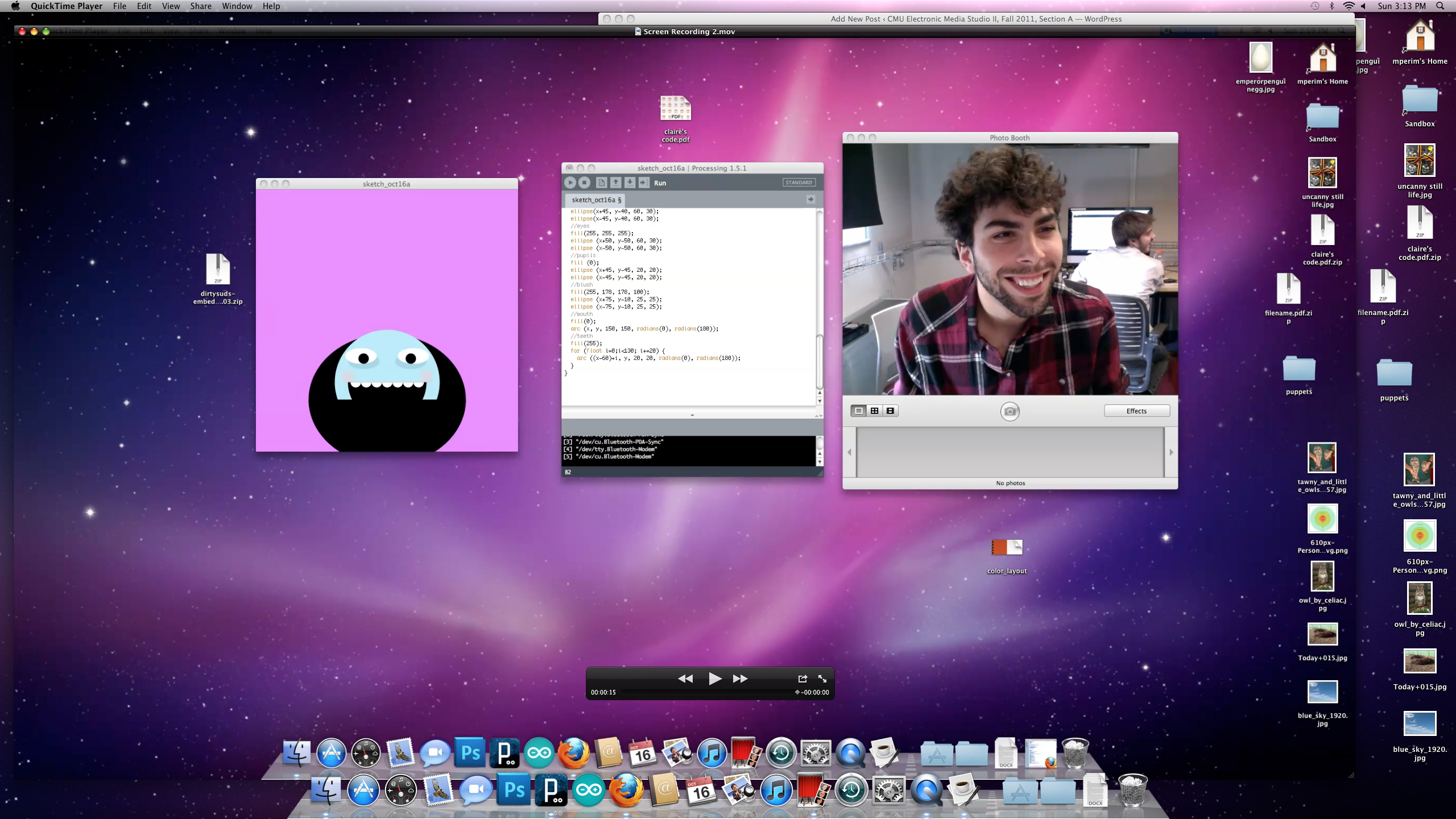
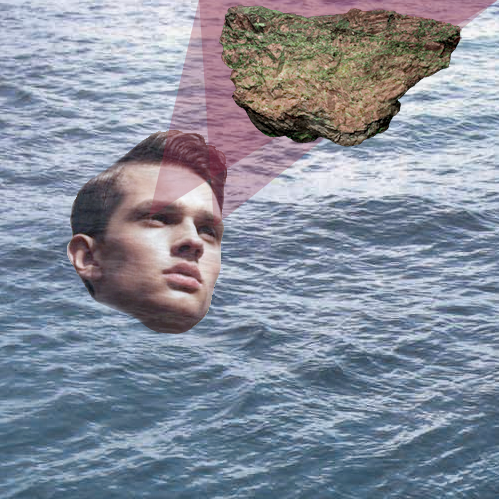
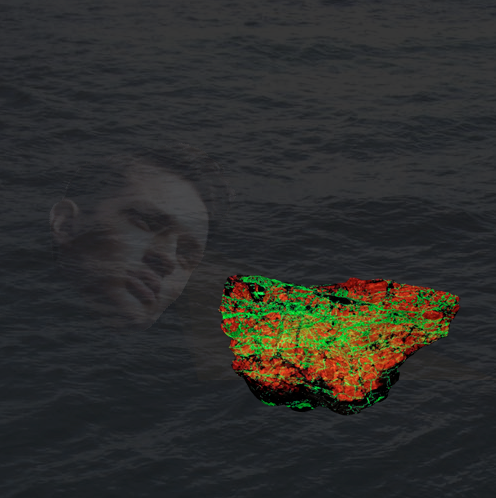
Arduino controlled Processing application, with interactive potentiometer and light sensor. Potentiometer controls levitation of rock, while the light sensor activates the fluorescent mineral.
Sensor Valley– by Daan Roosegaarde
http://www.studioroosegaarde.net/project/sensor-valley/photo/#sensor-valley
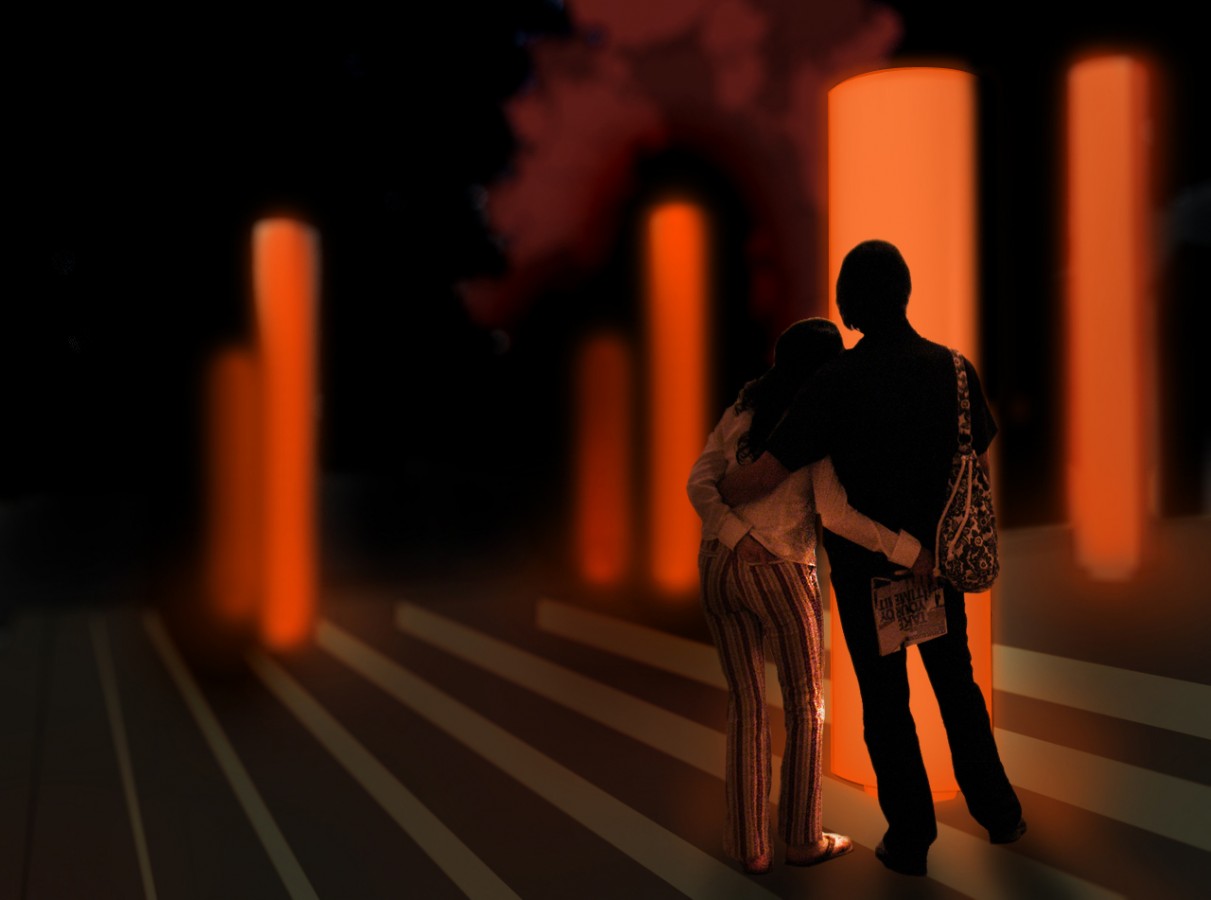
Sensor Valley is a large scale installation intended for a public space. It consists of large internally lit pillars scattered across the steps of Cultural Center in Assen, Netherlands. The pillars respond, with light, color, and audio to the touch and motion of the people around it. I like how this project takes sensor data and uses it on a large scale to activate public space. Although this project isn’t completed yet, I can imagine that it would function like a public fountain. However, I would think it would succeed in engaging a larger portion of it’s audience than public fountains, which usually engage small children, their parents and the randomly adventurous.
The Tropism Well – by Poietic Lab
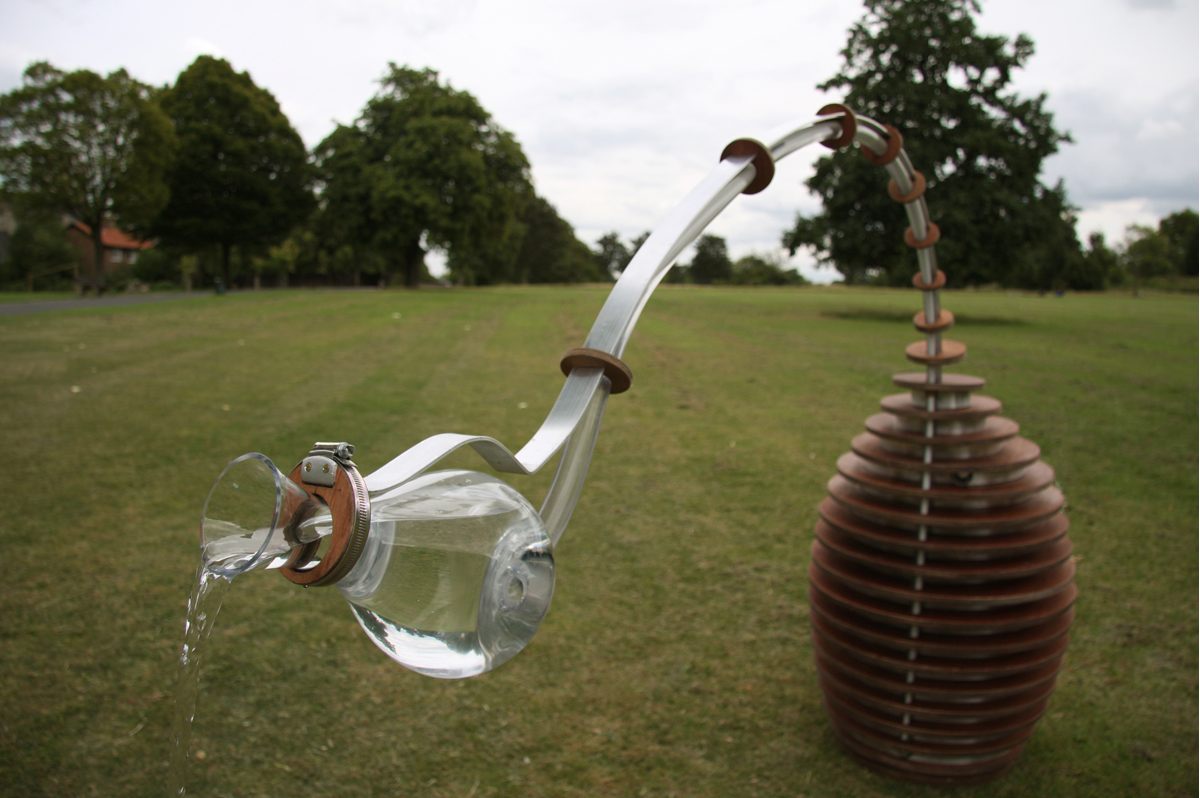
This project is a hybrid between fountain, sculpture and drinking fountain. This sculpture literally bends over and pours you a drink. It has a large and cleverly disguised water container as it’s base and a long tubular neck with a water pitcher attached to the end of it. When the sculpture detects the presence of viewer it will tip over and pour out a short stream of water. On one had it is hilariously impractical, but on the other it has an elegant and engaging quality. It’s purpose is somewhat of a kind and and unnecessary gesture. On the the project site they included a sketch of a whole flock of these sculptures. I really liked the idea of a conglomeration of these sculptures.
Audience– by Chris O’shea
http://www.chrisoshea.org/audience/gallery
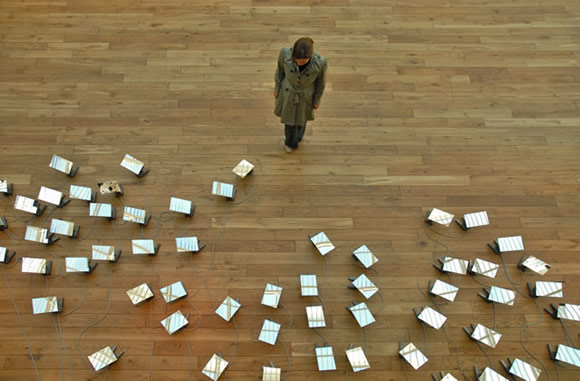
Audience is an installation of 64 “mirror objects” that seeks to reverse and make commentary on the audience viewer relationship. Each mirror is mounted on a rotating platform that gives each mirror the appearance of being a head swivelling on a neck. Each of the mirror objects is programmed with it’s own personality, some are shy and some more gregarious. The mirrors “chat” amongst themselves as a default state. However when a viewer is detected all the mirrors will “look” at that person. The mirrors follow the movement of a selected audience member and shine their reflection back at them. I thought this project was the most innovative and conceptual out of all the ones I looked at. I like how the mirrors on one hand take on the appearance of the viewer, but they also have preprogrammed personalities of there own. Additionally, I enjoy the fact that this installation creates a very subjective experience; If you are being tracked only you and those in your very close proximity to you will be able see your reflection in all the mirrors. Consequentially, looking at this installation would be both a very public and private experience simultaneously.
I think I forgot to do the last looking outwards so I found 6 projects for this time.
1) Niklas Roy’s “My Little Piece of Privacy”
Niklas Roy\'s \"My Little Piece of Privacy\"
This project involves using a surveillance to detect motion outside of a window and have a shade respond to that movement to prevent the passerby from looking in. I think the idea behind this is clever; it allows the person inside to have natural sunlight and scenery of the outside while maintaining some privacy. The practical implementation does not work so well in that the shade lags when responding to faster motion and has to overcome the obstacle of having two separately moving body at different sides of the window. However, I think the shade is successful in creating in unexpected interactive, entertaining experience in the midst of everyday life. As the video shows, those who are engaging with the shade appear to be highly amused by it. Further, as the shade grabs the attention of the passerby, even with the above mentioned problems, the person inside does experience a sense of privacy because they seem to “disappear” in the background of the interactive installation.
2) “A Goofy Movie – After Today LIVE”
\"A Goofy Moive – After Today LIVE\"
This is a live version of the song “After Today” from “A Goofy Movie”. I really enjoyed it one, because “A Goofy Movie” is awesome and two, because I thought the progress of how the video came to be made is really interested. It is based off of an animated movie, which, being animated, is based off of physical human interaction on the world. So in a sense, the makers of the video are translating information from a physical world to a virutal one and back into the physical one. Being the video aimed as being a close replica of the original with physical interaction, it still involved a lot of digital touching to get some of the scenes to look like. This is then almost a turn of the tables because the makers used digital technology to make the something human appear more animated when animation is usually attempting to use digital technology to make things appear more human.
3) Christopher Paretti’s Speed Dial
This project is an attempt to “use the phone as a gateway into something different, yet still very social, and enjoyable.” The artist created a miniature racetrack for slot cars that move based on noise and spit of a user into a phone. The idea is engaging for a user because it creates immediate feedback in a game setting in a new way; it is essentially using the phone like you would a joystick or any other type of controller. The difference is that you interface with the controller with your mouth instead of your fingers. I think this is project in that sense is fun for the user as a new, first-time experience, but I don’t think it necessarily will have the ability to entice people to use it again.
4) Noriaki Okada and Soyoung Park’s “Interactive Dolls”
I like the concept of this project because it aims to use technology in a meaningful, educational way by creating interactive dolls to help children develop language and social skills. I think that this is a good application of physical computing because such dolls capture the imagination of the child by creating pseudo-human interactions in a fun, silly way. The main criticism I have of this project is that I think some work could be done to make the interactions and the phrases more realistic/applicable.
5/6) Nortd Lab’s “Cubit” and Daniel Hirschmann’s “Glowbits”
Both of these projects explore the idea of the visual image through pixel manipulation. “Cubit” does so by creating an interface that allows the user to physically manipulate pixels by eliminating the use of a mouse. This is an interesting approach because it makes the idea of the pixel seem more tangible and begins to give it life outside of the 2d virtual environment. However, I think this is somewhat hinders by the design of the object itself; it’s shape and screen interface still too clearly mimic that of a regular, everyday computer. I think it would be more interesting to find a way to creating such an experience a more “out of the box” setting.
“Glowbits” is an attempt to draw with pixels in 3d space. I think this concept is a really cool one to explore, as it also is a defiance of the typical 2d virtual environment, and further begins to give pixels physical attributes, in a sense. I think that the movement of the 3d “pixels” begins to speak to this idea of physicality and to a certain extent, gives you the ability to experience it from different views besides the frontal one (though the frontal one is obvious the point of most interest). However, I wish the 3d “pixels” themselves could be better experienced from multiple viewpoints (instead of just the rods holding them), as it still seems to have a sense of linearity that suggests more of a 2d surface.
Electronic Instant Camera by Niklas Roy
<iframe width=”560″ height=”315″ src=”http://www.youtube.com/embed/wt5dBrXg8eY” frameborder=”0″ allowfullscreen></iframe>
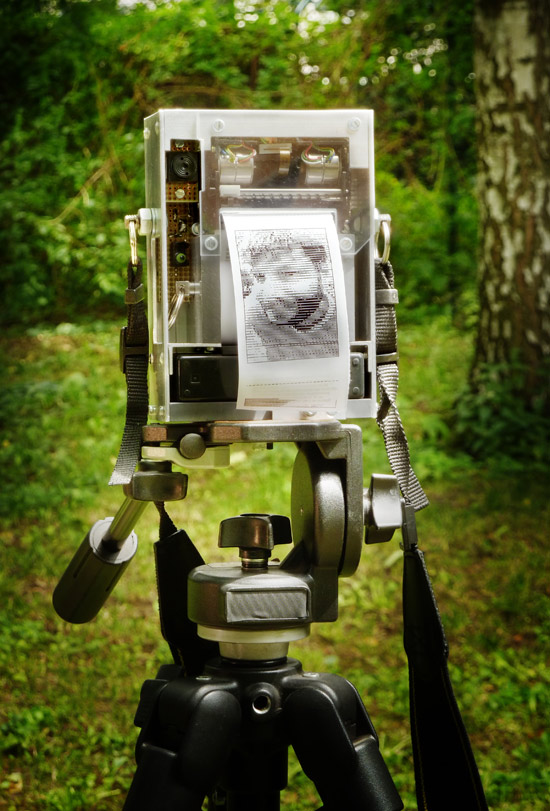
Niklas Roy’s electronic instant camera is an ATmega8 camera that takes and prints the images of its subjects on thermal receipt paper. This devices has elements of Polaroid and digital cameras, but rather than storing the pictures on film or digital data, it streamlines the process by printing the image directly on the thermal paper as it simultaneously snaps the picture. A microcontroller is used to connect the camera and printer. I really liked the graphical, high contrast of the the final portraits taken. The subjects sit and wait for three minutes as their photograph is printed, and I like how this detail undermines the expectations of the subjects–they think they are getting their photos taken by a high tech machine but it is very low tech and accessible.
Four Letter Words by Rob Seward
<iframe src=”http://player.vimeo.com/video/10437744?title=0&byline=0&portrait=0″ width=”400″ height=”225″ frameborder=”0″ webkitAllowFullScreen allowFullScreen></iframe><p><a href=”http://vimeo.com/10437744″>Four Letter Words</a> from <a href=”http://vimeo.com/robseward”>Rob Seward</a> on <a href=”http://vimeo.com”>Vimeo</a>.</p>
project in progress blog: http://robslog.tumblr.com/
I think this is just a really beautiful, playful and elegant piece. Rob Sweard’s Four Letter Words is contrived of four arduino units programed to display all 26 letters of the alphabet through the medium of fluorescent lights. The units are synchronized to form a very wide spectrum of words, which are “algorithmically generated word sequence derived from a word association database developed by the University of South Florida.” The algorithms that govern the arduino units are conscious of “word meaning, rhyme, letter sequencing, and association when they preform.” The florescent lights attached to the units move with such splendid fluidity. This work deals with textual art in a really interesting manner.
“Funktionide – New Promises” by Stefan Ulrich
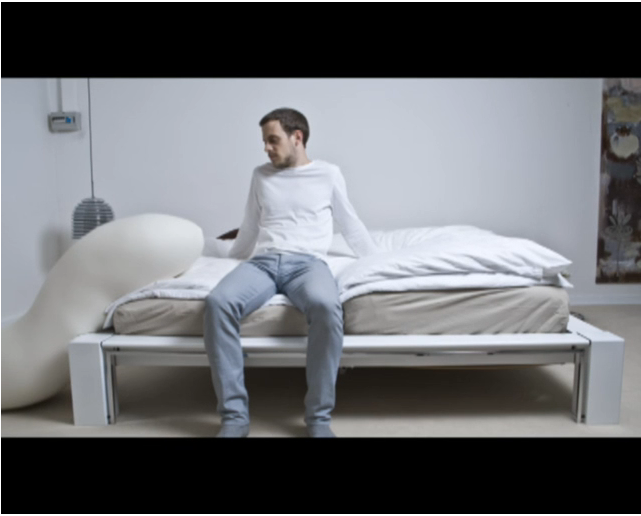
I love this video, funktionide’s interaction with the figure is so bizarre!
<iframe src=”http://player.vimeo.com/video/5509560?title=0&byline=0&portrait=0″ width=”400″ height=”320″ frameborder=”0″ webkitAllowFullScreen allowFullScreen></iframe><p><a href=”http://vimeo.com/5509560″>Funktionide Part II</a> from <a href=”http://vimeo.com/user1964837″>eltopo</a> on <a href=”http://vimeo.com”>Vimeo</a>.</p>
“The works intention is to provoke a discussion which enables us to question how much we want technological products to satisfy our emotional desires.”
This project is Stefan Ulrich’s bachelor thesis, a project where he researched new materials to try and alter our interactions with different products. He wants the objects we see as inanimate to come alive, and he does this with code and arduinos. The first video is a prototype for what will be funktionide, a “…a white amorphous object whose intention is to provide the owner with an atmosphere of presence to counteract feelings of loneliness.” Funktionide has such interesting potential for the future, I love the working design for the piece as well.
<iframe src=”http://player.vimeo.com/video/5421831?title=0&byline=0&portrait=0″ width=”640″ height=”360″ frameborder=”0″ webkitAllowFullScreen allowFullScreen></iframe>
-source: http://vimeo.com/5421831
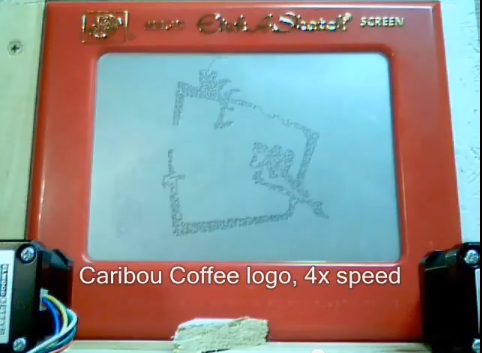
The Sketchduino is an arduino-based project which converts BMP files into Etch-A-Sketch creations. This video shows a rendering of the Caribou Coffee logo. Information and source code can be found here.
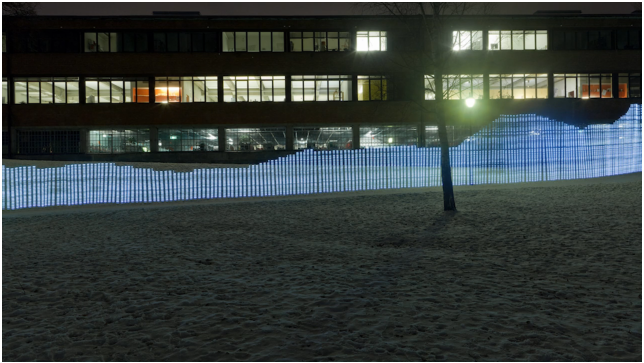 Immaterials: Light painting WiFi from Timo on Vimeo.
This project explores the invisible terrain of WiFi networks in urban spaces by light painting signal strength in long-exposure photographs.
A four-metre long measuring rod with 80 points of light reveals cross-sections through WiFi networks using a photographic technique called light-painting.
More here:
nearfield.org/2011/02/wifi-light-painting
yourban.no/2011/02/22/immaterials-light-painting-wifi/
Behind the scenes: yourban.no/2011/03/07/making-immaterials-light-painting-wifi/
”
I had just moved to a new apartment, and was constantly looking up directions on my phone. It would have been a fine solution, except I was usually biking while doing so. I wanted to create a safer option for people who use their phones to give them directions while biking.
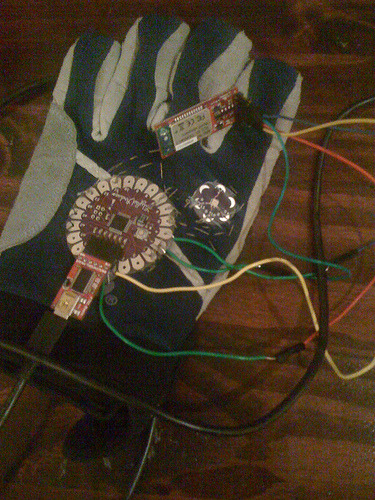
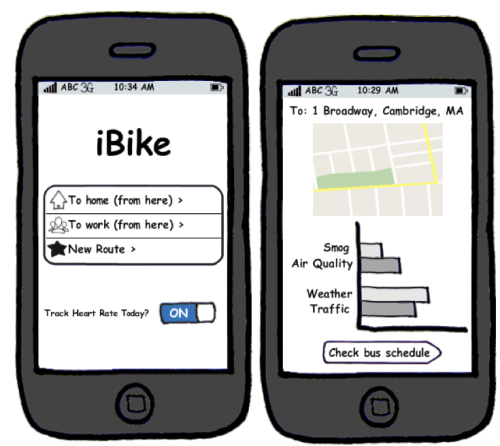
For my Tangible User Interfaces course, I worked with two other students to design a system where a user could look up directions on their (Android) phone, and then safely store it in their backpack. The phone would communicate over bluetooth to a microcontroller, which would cause either the left or the right glove to vibrate to indicate a right or left turn approaching.
I was responsible for the gloves, and sewed in a microcontroller, LEDs, and vibrating motors. I also programmed the microcontroller in C so that it would control the operation of the LEDs and motors, and helped create the interactive mockup of our “app”.” – Margarita Miranda