Looking outwards_Claire
Mud Tub, Tom Gerhardt
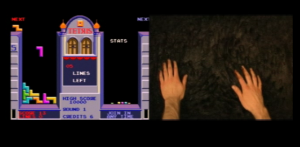
In this work, Tom Gerhardt stresses the organic quality of mud as a medium for user interaction.”By sloshing, squishing, pulling, punching, etc, in a tub of mud (yes, wet dirt), users control games, simulators, and expressive tools; interacting with a computer in a new, completely organic, way. Born out of a motivation to close the gap between our bodies and the digital world, the Mud Tub frees the traditional computer interaction model of it’s rigidity, allowing humans to use their highly developed sense of touch, and creative thinking skills in a more natural way.” (tomgerhardt.com) He claims that mud is inherently adaptable, that it’s tactical qualities force the user to relate more closely with the interface.
I think that there is something quite funny but relevant about the mashup of the digital world with something as analog as dirt. I feel that in a world that is increasingly focused on the virtual, it is pertinent to address the tactical as well.
Body Navigation, Ole Kristensen
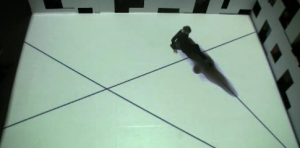
In this piece, Ole Kristensen has created an interaction between the program and the body in the form of a dance performance/installation. “Two dancers and their digital reproduction are the scenographic frame of this humorous and emotional portrait of human relations. based on rules and structured in a game like manner, the installation makes way for a playful dialog between the man, woman and the digital “footprints” they leave behind.” (3xw.ole.kristensen.name) Processing was used to track the dancers so that their realtime movements directly correlated to the graphics generated.
While I am not sure if this particular piece was the most successful overall, I do think that the idea of a duet between the human and the computer is a powerful idea and that there are many other potential works that could develop in this vein.
Interactive Robot Painting Machine, Benjamin Grosser

Benjamin Grosser created an installation featuring (as titled) an Interactive Robot Painting Machine. It uses artificial intelligence and listens to its surroundings to make artistic decisions; the machine creates its own body of work. “In the absence of someone or something else making sound in its presence, the machine, like many artists, listens to itself. But when it does hear others, it changes what it does just as we subtly (or not so subtly) are influenced by what others tell us.” (bengrosser.com)
Primarily, this is an exploration about intelligence. Grosser questions, “as these systems grow in complexity, or intelligence, how does that intelligence change what passes through them? Further, how does that intelligence evolve to make its own work for its own needs?(bengrosser.com) I am more interested in the motivation behind the work, and the process of making the individual paintings then the final paintings themselves. The conversation about the validity of critique that the interactivity of the robot brings up is especially interesting to me.
Terrific research Claire. Thanks.