Project 13 PDF
Comments Off on Project 13 PDF
“Art Computer”- Hiroshi Kawano
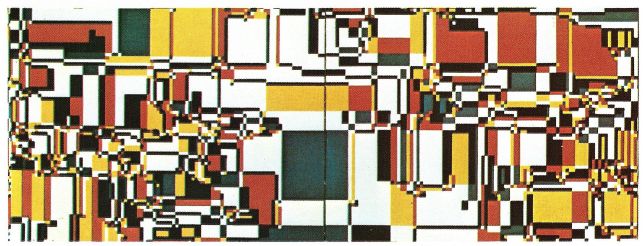
Hiroshi Kawano (*1925) was a Japanese philosopher and a pioneer of computer arts. I came across an essay of his at http://www.atariarchives.org/artist/sec33.php in which Kawano argues that computer arts are different than any other form of art. Specifically, computer art is the only form art where the artist is non-human, the artist is a computer. Kawano doesn’t view the programmer’s role as an artist; rather he views the programmer as a kind of parent or teacher to the computer, who is the true artist. He calls the computer that generates art, “the art Computer”. He thinks it isn’t important and that it is in fact detrimental for the programmer to have his or her own aesthetic tastes. He says that the programmer must maintain “a rigorous stoicism against beauty”. Instead, he believes that the programmer’s role is to discover the science of aesthetics and teach it the “art computer”.
“an ‘art computer’ cannot simulate a human art until the algorithm of art is found and described as a program.”
We Feel Fine- by Jonathon Harris
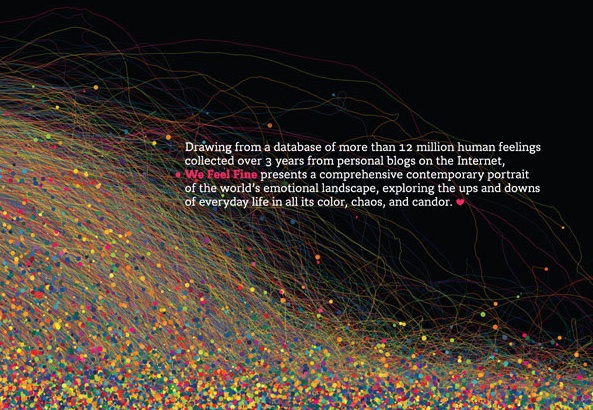
Jonathon Harris builds programs that creatively utilize the massive amounts of data available on the web. This particular program scans all the blogs across the web, looking for the phrase, “I feel” or “I am feeling”. It then channels this data into a variety of possible visualizations, that effectively map how the web is “feeling” at any particular moment. It also includes data about where each particular feeling is coming from, like weather, gender and age. The data is displayed dynamically, so that it interacts with the mouse. The user can also interface with the program by choosing different visualization options.
The resulting program is more playful than artistically moving. However, this project did open my mind to the possibility of using live data from the web and integrating it into a visualization. In fact the API used to make this site is free online at http://www.wefeelfine.org/api.html.
The Jonny Cash Project – by Aaron Koblin

http://www.TheJohnnyCashProject.com/#/explore/TopRated
the Jonny Cash project is a collectively made music video that memorializes Jonny Cash. Each frame of the video is rotoscoped by a volunteer from the web. The resulting video is an odd juxtaposition between the feeling of flowing video footage and unique hand drawn frames. Each frame of the video was rotoscoped several times and the viewer can choose the genera of frames they want to see. For example you can choose to see only the “most realistic” or the “highest rated” rotoscoped version of each frame.
I like the idea of tapping into the potential for audience involvement that the web has to offer. There is an interesting parallel between physical and virtual projects that utilize some sort of participation.

... what does this mean ?
The trailer tells us very little about what Joe Davis is doing (except for the fact that he is doing something quite “different”). Although, we can figure out from the blog post and the trailer that Joe Davis is also trying to communicate with the Aliens. His methods combine art with science. A movie was just made about him, which you can find here: http://www.we-make-money-not-art.com/archives/2011/09/heaven-earth-joe-davis.php. Davis works at MIT and is an artist/scientist who sounds like such the genius. One of his goals is to find a way to spread things such as “hope” (perhaps through bacteria); things which are not part of human DNA, but make humans so much of what they are.
___
I would also recommend taking a look at Daniel Eatock’s website. Maybe it’s ironic that his last name is Eatock because a lot of his work has to do with food. I was drawn into his website because of the fast food photographs, which creatively mock advertisers play-on-words when it comes to showing us what to eat (with packaging, billboards, ads, etc). You can get to his website from here: http://eatock.com/

a full packet of crisps chewed into a pulp, spat out, and formed into the shape of a potato.
_____
Also, take a look at these photos. They are various photojournalist photos from the past year, and some are bound to at least make your eyes open wide. http://www.we-make-money-not-art.com/nor-index.php?page=3 . The images go through various disasters from the past year. What a powerful planet we live on.

Javier Manzano, northern Mexico, 02 June 2010
Social Fireflies
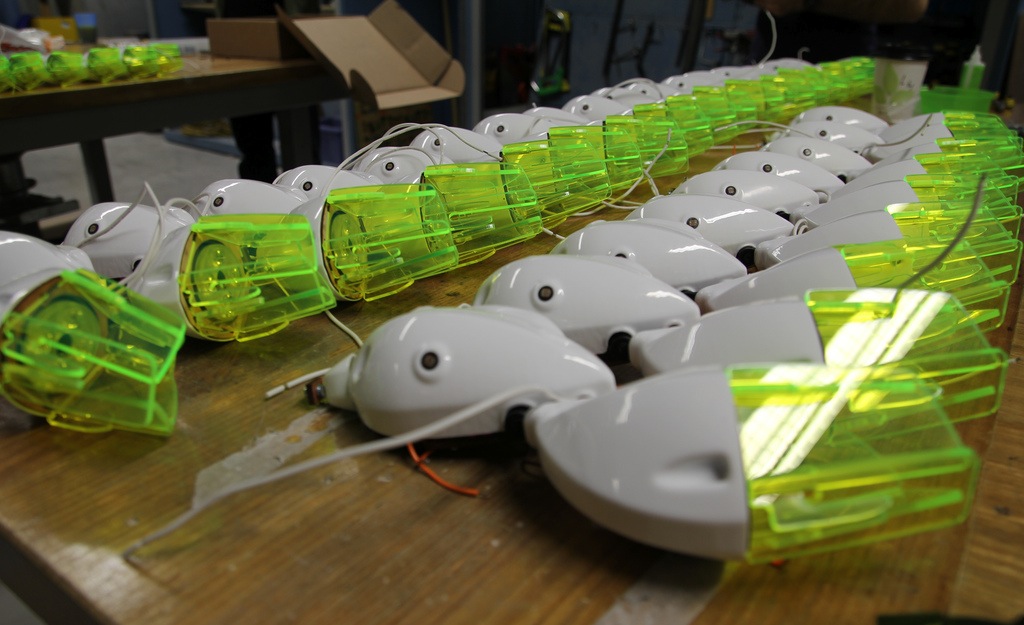
Social Firefly, constructed by Jason McDermott, Liam Ryan, and Frank Maguire, is a community of intelligent lights that interact and influence one another by responding to lights made by other lights. More popular lights, which are located closer to other Firefly lights, become highly influential within their community, while more isolated lights have a harder time communicating to their friends. Viewers can also communicate with the Fireflies by shining lights on them. Social Firefly is designed to show users the relationship they have to other creatures that inhabit the Earth.

‘Simple Harmonic Motion’ installation
‘Simple Harmonic Motion’ is an ongoing research and series of projects by Memo Akten, a visual artist, musician and engineer, that explore the complex patterns that are created from multi-layered sound and music. The video is mapped on a cylindrical display made of 5,600 silicon rods, allowing the audience to view from inside and outside. Akten’s visual designs gain inspiration from the rhythmic motions of pendulums.
Les Objets Impossibles – Objet 1 (excerpt) from Abstract Birds on Vimeo.
Les Objets Impossibles
Les Objets Impossibles is a live audiovisual concert by the two visual music artists, Pedro Mari and Natan Sinigaglia aka Abstract Birds. During the performance, each musician of the Ensemble will be analyzed separately in Max-MSP, and the resulting data generates the visuals. Abstract will interact in realtime, controlling several parameters of the piece, as well as directing the camera movements.
Andy Jordan from the Wall Street Journal, covers a performer who uses technology to enhance his art. Andrew Schneider, a graduate from NYU, has come up with many different, mostly wearable, technologies that push the boundaries of communication. He is exploring who we are, our ideas, and how we, as people, connect, and he wants to break the wall between audience and performer.
He has made things like shoes that create music loops, a camera that is programmed to take a picture when he blinks, and helmets with attached screens that allow two people to talk for each other.
simultaneity » The Wall Street Journal covers Experimental Devices for Performance!.
 David Rokeby’s “n-cha(n)t”, shown here at the Walter Phillips Gallery at the Banff Center for the Arts, came from the desire to “hear a community of computers speaking together”. The installation consists of a series of monitors displaying pictures of human ears that chant words. These monitors are then linked by a network of microphones and voice recognition software that allows them to “intercommunicate” with each other as well as the audience. When the system is left uninterrupted, the monitors synchronize and chant similar words. However, when the audience speaks or makes noise in the gallery space, it shifts the computer network away from the “synchronized chant” and into a “party-like chaos of voices” to simulate an alteration in “state of mind”. I found this piece was a unique way of giving human-like features to computers by having them interacting with both the audience and each other.
“David Rokeby : N-cha(n)t.” Web. 10 Sept. 2011. <http://homepage.mac.com/davidrokeby/nchant.html>.
Media Circus by Michael LeBlanc is “a scrolling marquee that displays amusing headline news mash-ups”. I found this idea interesting because of its use of new-media technology to create a commentary on the quality of news that is often broadcasted. The piece is still being fine-tuned but I thought its concept was worth taking a look at. The idea for the program that operates the marquee came from the Dadaist use of “cutting up” phrases and re-organizing them to show different meanings. The marquee runs on an Arduino Duemilanove and is programmed to retrieve headlines from two Canadian news services and recombines them to display twenty new phrases.
>>>Watch the video at: http://youtu.be/aVGS3WXhD3E
LeBlance, Michael. “Intellectual Curiosity (求知欲) » Blog Archive » Introducing Media Circus.” Intellectual Curiosity (求知欲). Intellectual Curiosity. Web. 10 Sept. 2011. <http://leblanc.co.cc/?p=960>.