Sarah Keeling LookingOutwards, Scenario

LookingOutwards — sarah_keeling @ 4:32 pm


Scenario is a “360-degree 3D cinematic installation” that combines narrative with an audience’s interaction with a humanoid character to create a new kind of cinematic experience. The humanoid character is equipped with artificial intelligence and processes the audience’s reactions to the ongoing narrative. It then responds to these reactions by trying to block the audience at varying points of the plot line, which creates a different experience each time it is viewed. I thought the space created by this piece was interesting and appreciated the use narrative in an interactive project.

UNSW College of Fine Arts Engineering. “Scenario.” Icinema: Center for Interactive Cinema Research. UNSW College of Fine Arts Engineering. Web. 10 Sept. 2010. <http://www.icinema.unsw.edu.au/projects/scenario/>.


Studio Roosegaarde

LookingOutwards — stephanie_shulman @ 3:34 pm

Flow 5.0 by Daan Roosegaarde


Studio Roosegaarde’s focus is human interaction. Headed by Daan Roosegaarde, the team creates pieces that move and react to peoples’ movements and sounds. These “living objects” span from installations of plant like objects, such as Dune and Lotus, to simple walls and objects, like Flow and Lunar, to more complex objects that can change their size and shape, like Liquid Space and Liquid 2.0, and even to fashion, as seen in Intimate.

One of the most interesting works, in my opinion, is the Sustainable Dance Floor. Basically, it transfers the energy of dancers’ footfalls into pure energy that is used to power the club. It fascinated me because it made me think about how much energy we create in our day-to-day lives that could be harvested in this fashion.


Studio Roosegaarde — Dune photos.

Looking Forward – Fake Town Squares

LookingOutwards — alex_mallard @ 3:08 pm

Seeing Stephanie’s post about the AI that predicts peoples reactions in emergency situations, I remembered seeing this post on one of my favorite blogs about an artist who creates fake aerial shots of fake town squares. The artist, Adam Magyar, creates these fascinating images by taking individual photos of people just a few meters above them, about 3 or 4, and stitching the individual photos together to form one large photo consisting of hundreds of people. Sometimes Magyar organizes the people into lines and other times they are completely random. On his website, you can zoom into a specific person to see what is going on with him.

The original post: http://flavorwire.com/206225/trompe-loeil-fake-aerial-photos-of-fake-bustling-squares#more-206225

Magyar’s website: http://www.magyaradam.com/

World’s Most Advanced Crowd Simulator Predicts How People React In Emergencies

LookingOutwards — stephanie_shulman @ 1:08 am


This new software, by Oasys Limited, predicts the movement of thousands, if not millions, of people as they interact in space. The simulator creates patterns for people as they pass through spaces in different situations. For example, in the case of an emergency that calls for an evacuation, the software can predict the amount of people that try to get to each exit, and how long it would take for everyone to evacuate. It takes into account the size of exits, walls, obstacles that might be in the way of escape, so that designers and architects can alter drawing plans for buildings, stadiums, and the like. What impresses me is that the program can simulate many different personalities of people and predict how their personality affects how they move through a space.


World’s Most Advanced Crowd Simulator Predicts How People React In Emergencies | Fast Company.

Looking outwards_Claire

LookingOutwards — claire_gustavson @ 6:50 pm


Mud Tub, Tom Gerhardt
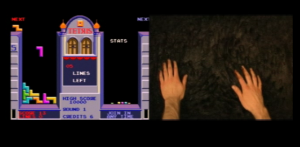
In this work, Tom Gerhardt stresses the organic quality of mud as a medium for user interaction.”By sloshing, squishing, pulling, punching, etc, in a tub of mud (yes, wet dirt), users control games, simulators, and expressive tools; interacting with a computer in a new, completely organic, way. Born out of a motivation to close the gap between our bodies and the digital world, the Mud Tub frees the traditional computer interaction model of it’s rigidity, allowing humans to use their highly developed sense of touch, and creative thinking skills in a more natural way.” (tomgerhardt.com) He claims that mud is inherently adaptable, that it’s tactical qualities force the user to relate more closely with the interface.

I think that there is something quite funny but relevant about the mashup of the digital world with something as analog as dirt. I feel that in a world that is increasingly focused on the virtual, it is pertinent to address the tactical as well.


Body Navigation, Ole Kristensen
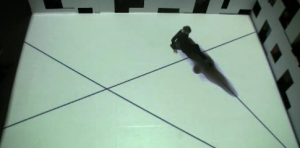
In this piece, Ole Kristensen has created an interaction between the program and the body in the form of a dance performance/installation. “Two dancers and their digital reproduction are the scenographic frame of this humorous and emotional portrait of human relations. based on rules and structured in a game like manner, the installation makes way for a playful dialog between the man, woman and the digital “footprints” they leave behind.” (3xw.ole.kristensen.name) Processing was used to track the dancers so that their realtime movements directly correlated to the graphics generated.

While I am not sure if this particular piece was the most successful overall, I do think that the idea of a duet between the human and the computer is a powerful idea and that there are many other potential works that could develop in this vein.


Interactive Robot Painting Machine, Benjamin Grosser
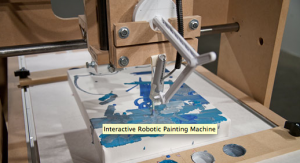
Benjamin Grosser created an installation featuring (as titled) an Interactive Robot Painting Machine. It uses artificial intelligence  and listens to its surroundings to make artistic decisions; the machine creates its own body of work. “In the absence of someone or something else making sound in its presence, the machine, like many artists, listens to itself. But when it does hear others, it changes what it does just as we subtly (or not so subtly) are influenced by what others tell us.” (bengrosser.com)

Primarily, this is an exploration about intelligence. Grosser questions, “as these systems grow in complexity, or intelligence, how does that intelligence change what passes through them? Further, how does that intelligence evolve to make its own work for its own needs?(bengrosser.com) I am more interested in the motivation behind the work, and the process of making the individual paintings then the final paintings themselves. The conversation about the validity of critique that the interactivity of the robot brings up is especially interesting to me.
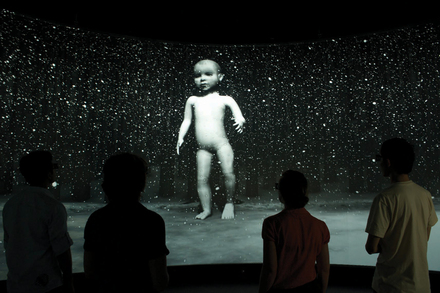


Looking Outward

LookingOutwards,Uncategorized — jennifer_moreci @ 2:22 pm


Mirror Space

This video captivated me because of its use of biofeedback.  The inclusion of mood analysis in the piece is what truly becomes interesting about the entire work.  The division of humanity and machine becomes blurred.  The intersection of these two varying subjects gives a whole new meaning to the image that is portrayed.  In a strange way, the individual pictures become unique portraits.  Perhaps these portraits are even more telling than one just a well rendered and articulated painting or drawing of an individual’s face.  The formal act of interaction is minimal, but the results yield insightful and highly interactive.  The work cannot exist without the individual.


Sound


Though I believe this piece is far from reaching it’s full potential, it touched on an interesting theme that got me questioning what it could become.  The use of motors in combination with the arduinos becomes of sort of simulated wind.  The types of noise making materials the artist chose further amplifies this notion.  I therefore became much less interested in the sounds that were being made, but by how they were being made.  This piece touches on the phenomena of machine replaces natural function.  Even moreso the potential for machines to replace the natural course of things, or replace humans.  Though the relationship between these grand ideas and work seems small,  I still couldn’t help but see the machines as a replacement for natural wind.


Augmented Ears


I find the styling and aesthetics of this piece incredibly distracting from the beauty of the concept.  To me, this is a perfect example of trying too much, or overshadowing the concept.  The leading and defined documentation does not help either.  However, the basis of the work I find to be very strong.  There is something truly profound about the ability to hear the world as we want it.  Also, the large range of variation and choice the artist gives the viewer creates an even more dynamic experience and artwork.

Looking Forward – US Post Offices

LookingOutwards — alex_mallard @ 12:15 am

Derek Watkins created a fascinating program that enables the audience to view the expanse across North America by mapping the growth of all of the U.S. Post Offices. Through the very simple visualization of new U.S. Post Offices appearing across the states, you can track how different eras affected expansion. For example, as the California gold rush begins, you can see a sudden boom in the number of Post Offices on the way out west. I find this progression fascinating to watch and an interesting way to look at how Americans moved across the U.S.

Looking Outwards – Keith Lafuente

LookingOutwards — Tags: — keith_lafuente @ 3:54 am

My Little Piece of Privacy – Niklas Roy

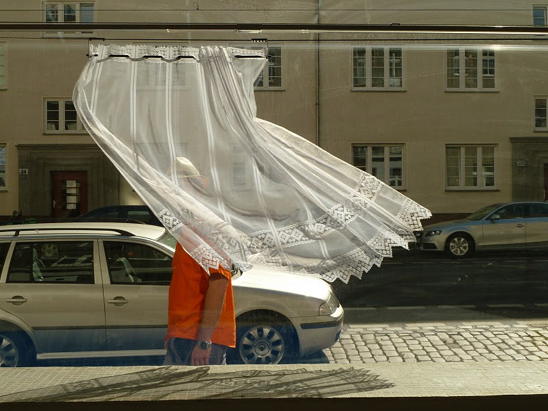
Niklas Roy wants more privacy. His studio has a large window that faces the street. As a solution, Roy took a very small curtain and combined it with a mechanical system that is programmed to move the curtain according to the position of a passerby. Using a camera that detects motion, Roy’s program tells the curtain where to go in order to precisely and effectively block the view of an onlooker into the studio. Contrary to its purpose, the installation amusingly attracts more attention than it avoids. Roy uses a simple premise to successfully transform public space into an unexpected and unusual experience.


Captured: An Homage to Light and Air Nils and Sven Völker at MADE space, Berlin

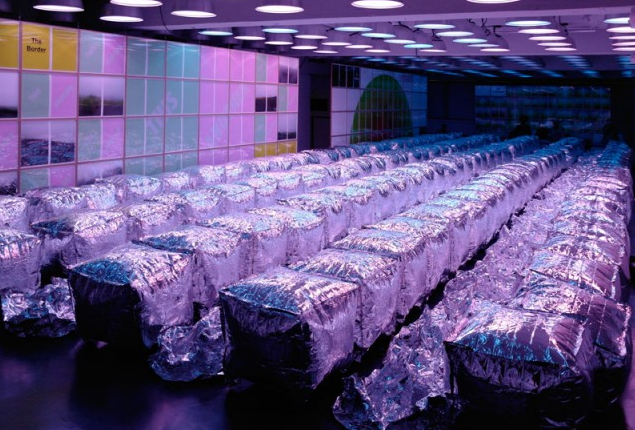
An installation that resulted from the collaboration between artist, graphic designer, and arduino attempts to pay homage to the light and to the air. Silver air bags are choreographed (through the use of processing and an arduino) to inflate and deflate, along with music and changing colored lights. Prints line the walls, declaring vague statements like “The Border” and “The Volume”.

I enjoy the air bags particularly, which have their own mysterious and uncanny beauty as they inflate and deflate in a strangely organic way. It is almost as if they are breathing, which seems contradictory to their artificial appearance. The sounds of the bag’s movements also adds another satisfying level to the sensory experience. On the other hand, the flashing lights were a little hokey and lend themselves more to a dance club than this particular installation. The prints on the wall also seem very disconnected from the air bag component; even the gallery introduces the project as when artist and graphic designer “clash”. I believe the piece would be a lot more interesting if the artist had concentrated and expanded on the use of the air bags instead of the lights or the prints.


People Staring at Computers – Kyle McDonald

People Staring at Computers is a program McDonald wrote and installed on various computers in Apple stores around New York City. The program took a picture every minute, and if it detected a face, the photo would be sent to McDonald’s server. The result was thousands of faces; truthful, unmediated, and surprisingly fascinating portraits of consumers and their relationship with technology. These portraits were ‘exhibited’ on the same computers that took the pictures.

The project would have continued to be interesting had it not been shut down by the secret service. The website has been taken down and the pictures have been censored with pictures of Steve Jobs. Kyle McDonald is now in serious trouble over this project, which obviously stirred up issues dealing with privacy rights. He could be sent to jail for twenty years for computer fraud. The strong reaction to the piece, though, makes it all the more interesting.


« Previous Page
This work is licensed under a Creative Commons Attribution-Noncommercial-Share Alike 3.0 Unported License.
(c) 2019 CMU Electronic Media Studio II, Fall 2011, Section A | powered by WordPress with Barecity