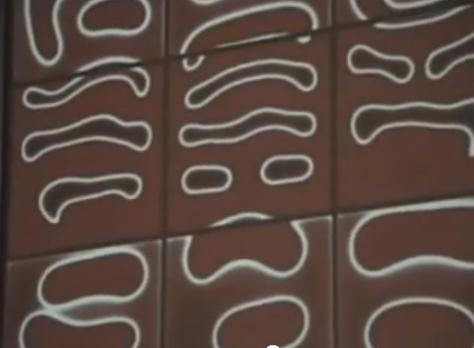
The creative studio dentsu, teamed up with photographer linden gledhill to create this series of paint sculptures using sound vibrations. the series was part of a campaign for canon’s pixma ink printer brand. the photographs and videos begin by wrapping a membrane around a small speaker. ink drops were placed on this membrane and the speaker was turned on. once it began to vibrate the ink begins to jump up and down. high-speed video cameras and still cameras were used to capture this including circling around the sculptures to see them from all angles. experimenting with different sounds and frequencies created the various pieces.
Skin”, an interactive installation made by the collective, Fy. This installation involves the use of Kinect, Arduino and Processing to create an interactive space. It lets the audience plays with a virtual plastic bag and as well as light up the physical ones, creating a unique experience of touching, hence the name, Skin.
Based around the metaphor of the conductor and the orchestra, the goal of the piece is to try and recreate the experience of the conductor. Sonic Interaction Design, which uses sound as one of the principle channels of conveying information, meaning and emotional qualities in the context, was employed on this piece. The user must feel in control of the music and how their actions have an affect on both the music and the visualisation. The aim is to take the musical experience of composing to a new level of interaction.
I found this link on OpenProcessing and it leads to a very cool interactive project where you click anywhere on the application and the image of a field (in this case a set of connected blue lines) wraps around the place where you clicked and expands the field to where you clicked. What is cool is that you figure out various ways to play with the application by trying for example to get many holes from the image apart as they tend to merge when they are near. It is a fun way to spend some time and I think simple applications like this one can make a boring place a bit more fun.
This is probably one of the most interesting virtual worlds created so far. The reason I share this link is because I think of the potential that virtual worlds have to make our encounters with art more interactive and our everyday life more interactive. In Second Life, you can travel to massive virtual places created entirely from peoples’ imagination and even some real life places like cities in Germany and Spain. It would be really cool if we could actually put on some goggles and just walk around the places in second life and truly interact with the objects. Like if someone creates for example a skyscraper, it would be really cool to actually be able to navigate it as if it were a real skyscraper. I just think that the potential of virtual worlds to make our daily lives more interactive is huge.
Microsoft Surface is a table version of a tablet PC but with lots of other features such as interactions with various objects, connection with other wireless devices, etc. The reason I post it is because it has many features that make it interesting as a constantly changing piece of interactive art. With it you can have multiple people drawing on a screen at the same time which seems like a fun activity for people. People like to get involved in group activities and having huge screens on walls, tables and other places seems like a good idea to get groups together painting or playing music or whatever other way the Surface can be used.
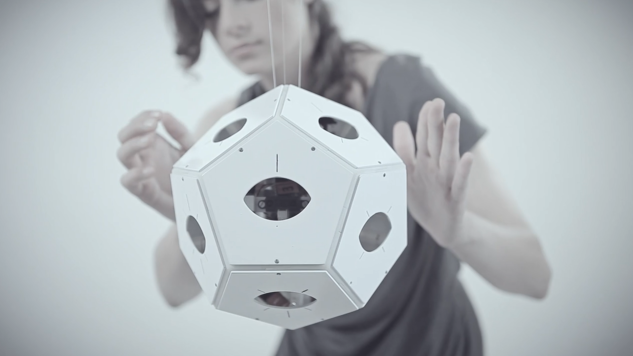
Despite the admittedly cheesy video and commercial use of dub step, I feel like the “Dodecaudion” shows an interesting combination of multiple technologies (like processing and arduino) to create an interactive, sound-generating device. I’d say this project could fit into the category of sculpture, but I feel like it also has the capacity to be a form of performative instrument. I’m most interested in the beginning parts of this video where the sounds generated by the “Dodecaudion” are harmonic and have a tempo set by the speed of the user’s hands. These features allow for a user to potentially master the object to perform intentional melodies or songs. The description says the project is still in its beginning phases, so I’d like to see where it goes.
I was thinking about interactive art and I couldn’t really remember ever coming into contact with an interactive artwork in a public space. The idea of an artwork affecting the space in which it is placed, like in the “Hand from Above” piece, seems very interesting. In that case, even though nothing is physically occupying the space in which the people are standing, it still causes people within that space to react. And then I remembered that I had seen something with a very similar effect before: the interactive projection games found on the floors of malls! Just like in the art work, these games cause people to react differently to a space where nothing is really any different. It’s still just a floor, but because of the projection it becomes an interactive space.
Something else that I remembered was an animation titled “Attraction” that I came across recently. It was commissioned by a French organization in order to spread a “anti-smoking” message. Apparently the film is meant to be viewed in an internet browser, and hooks up to the user’s webcam in order to involve the viewer in the action. Not having tried it for myself, I don’t know how “interactive” it really is, but the concept of actually having an impact on an animation is really exciting to me. Some “interactive” elements seem gimmicky, whereas focusing too much on user input seems to focus more on the user than the artist in some cases. An animation where the viewer has an effect, but does not completely control the work, seems like it could be really cool.
The thought of interactive animation made me think about video games. A very basic definition of a video game seems to be an animation that you control, where the decisions you make result in what you see on the screen. This game is called “Fotonica.” It is extremely simple, only using one button, however it is very enjoyable. It has a kind of relaxing mood to it that made me want to simply move along and go with the flow. One level is actually never-ending, and I found that level to be the most enjoyable. This game isn’t about winning, or even getting to the finish line necessarily, but I found this lack of a challenging goal made this game enjoyable and quite different from games I’m used to playing.
Drift Grid interested me because it was described as a responsive piece that reacts to the audience’s presence without depicting it. I feel like multiple pieces have explored the idea of reflecting a viewer’s image or shadow (like Rafael Lozano-Hemmer’s Eye Contact and Daniel Rozin’s multiple Mirror pieces), but this one attempts to accommodate to a viewer’s face, instead of replicate it. The piece, separated into four columns of drifting blobs, freezes the upward movement of any column (and the blobs in that column) when a face is detected in front of it. This allows not only for viewers to control the piece, but also for them to get a better look at it, to stop it, to maintain it.
I was initially really excited to explore Jeremy Rotsztain’s various “Action Paintings” when I saw the still image of one. Upon watching “Revving Motors, Spinning Wheels,” I concluded that I thought that the still image I originally saw was more pleasing than watching the video. I would occasionally pause the video just to take a look at what was on screen for that moment (and typically appreciated that more than just watching the thing play out). I feel as though the secret to the process is revealed by watching the movie, as at certain points the color and motion generated where very noticeably representational to the cars from the original movie footage. At some points I could just tell, “hey that’s the video of a car put through some filter.” This is also noticeable in with the explosions and debris in “Monochromatic Bursts of Color.” I also feel as thought the motion that is made with the paint is over-emphasized, and eventually loses its significance. I will say that the color schemes in each piece are satisfying and that the still images generated Rotsztain’s video editing are quite successful on their own.