Inspired by the animations that we made in class using the “living inks,” I found this cute little application that lets you draw pixel by pixel and create frames on animation. Peter Blaskovic is behind this. He was an animator for a long time and recently quit to work on his own pieces.On his website, he has more animations and things of the same sort that are focused on computer graphics and modeling. Check it out!
Last time, I talked a bit about games and animation, and how the level of interactivity determines how I view a video-based work of art. I was recently sent a link to a different game by one of my friends. It’s called Auralux:
This is a Real Time Strategy game, meaning the game is based on your strategy and decisions you make in real time (this is different from, say, a turn-based strategy game, which gives you unlimited time to make decisions when it is your turn). Unlike other RTS games, which often require you to use your speed as well as your strategy to defeat your opponent, Auralux is meant to be a relaxing game that is solely based on strategy. It is trying to be an RTS at it’s simplest, without all of the factors that make the profitable RTSs of today’s market stressful and complicated. I think this game is very interesting because, like the game (Fotonica) from my last Looking Outwards, it aims to relax the player, while still requiring skill. It becomes more of a soothing experience than an attempt to win, although winning is still your objective.
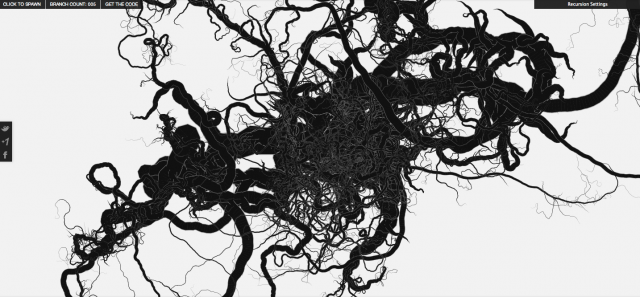
Super Recursion Toy
The next thing I found was this incredible looking art by Justin Windle, found on the creative applications website. The thing that drew my attention was the use of the word recursion. Recursion is the concept of doing something over and over again, such as a function calling itself. Not only do these snapshots of the program look extremely interesting, they also instantly made me think of a recursion program. So, for me, this is like a visualization of a “computer science work” into an “art work.”
WebGL
The last of my finds this week was found on a website called jocabola.com. While it seems that the use of the technology was limited in this case, apparently WebGL allows for interactive 3D graphics to be used in web browsers. Seeing this simple example made me wonder what it is capable of. It kind of reminded me of the “visualizers” in iTunes. Perhaps there will be a way to have your browser reacting to the music you are playing using the WebGL technology in the future. I think there are many possibilities for this kind of technology to make the internet interactive in an interesting way.
This is a neat video that I found that reacts to sound. It seems that the louder and more intense the music gets, the closer together the lines get. The user’s name who programmed this in Processing is SimonGeilfus, and he has a few other projects on his profile that combine music with beautiful and reactive visuals.
Evan Roth’s Multi-Touch Finger Paintings caught my interest because they are the opposite of what I expect: instead of integrating technology into art and making it a key point or focus, technology is used but is not displayed in the final result or piece. The concept and process interest me, but I’m not too sure how keen I am on the actual pieces. I’m most drawn to the simple or organized ones. “Slide to un-lock” and “12,345 + 6,789 = ” both have a legibility to
them where a display or detailed explanation is not necessary. Their titles are simple and the motions/patterns that the paint depicts fit well with them. I feel as though the pieces “Launch Twitter. Check Twitter. Close Twitter” and “Launch Mail. Read Mail. Close Mail,” give too much information in their titles and the paintings are convoluted. It gives away too much. “Slide to unlock” is reminiscent of a smart phone, however the paint marks are simple enough to a point of still being make-able without the hardware. Similarly “12,345 + 6,789 =” depicts a pattern of buttons pressed on a calculator, a universal tool. I guess I’m more attracted to those that could be ambiguous.
“Slide to un-lock” is seen below
Comments Off on Eric Mackie’s Looking Outwards 6 – Multi-Touch Finger Paintings
So.. I was at a party last night is a collaborative installation between Andrea Cuius and Roland Ellis which was commissioned by the poet Sabrina Mahfouzfor her solo show Dry Ice (which showed 20th – 23rd April 2011, at the New Wimbledon Theatre, London). It is composed of thirty custom tungsten lamps of various shapes, each with its own unique filament. As Mahfouzfor speaks, a microphone records her voice. The bulbs then respond to the frequencies and amplitudes of a performance by dimming or becoming brighter.
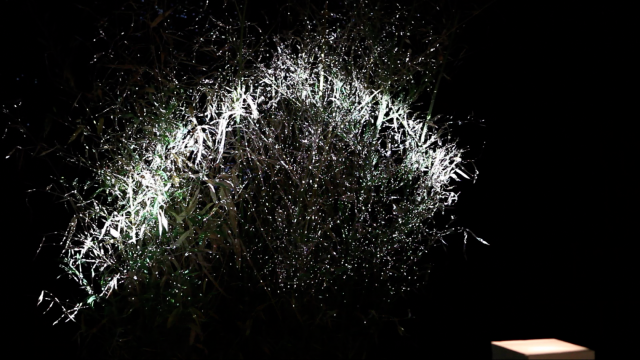
Lit Tree
Lit Tree by artists Kimchi and Chips is a structured light system that scans the location of every pixel of a bamboo tree in 3D, which allow a cloud of scattered projector pixels to highlight and dance around the contours of the plant. The visualization is also set to react to movements and gestures by viewers. The piece then interacts with the audience by making its own gestures.
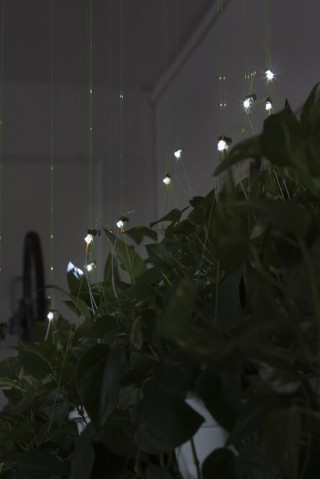
The Hanging Garden
The Hanging Garden is a collaborative project by The Clorofilas and Aer Studio. It consists of LED lights which respond to moisture levels in plants by lighting up when the plant needs water. Both The Clorofilas and Aer Studio stated that the motivation of this work was the the relationship between nature and technology.
OpenFrameworks developer Arturo Castro shows off his real-time face-swapping technology, created using Kyle McDonald’s ofxFacetracker, Jason Saragih’s facetracker library, and “parts of Kevin Atkinson’s image clone code.”
In the comments, Castro tells Atkinson he’s currently working on stealing someone’s face in real-time. Falling into the wrong hands in 3… 2…
I was interested in watching the video of One Hundred and Eight by Nils Volker because its description said that it made use of arduino, processing, and garbage bags: all things that we have access to and that we are learning to use (I assume we are all familiar with trash bags, already). The first thing that hit me with this piece is how organic it is. The pace and motion of the garbage bags inflating and deflating seemed to mimic human inhalation and exhalation, and it made watching it engaging and relatable. The piece is almost alive. From the description, I was expecting the piece to react to the audience’s presence more dramatically, or noticeably than it does. I do like, however, that it seems to stop, think, and then follow a viewer’s presence, almost like the living work has been caught off-guard and must become attentive to its surroundings now.
This is called an interactive fotolabor by Dirk Donut. So I can’t tell much about what this project is about, since the descriptions are all in another language that looks suspiciously like Swedish or something. However, from watching the video, I can tell that the projection interacts with the box and what the box contains. I believe that the projection senses the box that is passed underneath it and depending on how the box is tilted, it projects different things onto the blank surface. Additionally, you can also see how the projection maps the hand as it passes through the light.
Alexander McQueen Spring 1999
Over the summer, when I visited New York, I went to the Savage Beauty exhibit showcasing the work of designer Alexander McQueen. One of the pieces that it showed was a dress created at the Spring 1999 couture show. In the video, the model begins wearing a plain white tube dress and standing on a rotating platform with two robotic arms on either side of her. The arms react to her movement and sprayed paint of the dress.
Curtain Code
On OpenProcessing, I found this really cool code for a curtain program that does a really fantastic job of mimicing real fabric. The code was written by the member BlueThen. You can interact with the curtain by dragging and clicking, tear the curtain by right clicking and dragging, and toggle the gravity of the program by hitting ‘g.’ You can reset the program with ‘r.’
From what I know, software like this has been in the works for a while. The only things I’ve seen like it, however, don’t allow you to interact with what the camera is sensing, but only what is on the touch screen. I feel like, if applied to a touch screen larger than that of a smart phone (say, an iPad which would allow for more control), this software would be much more versatile and easy-to-use. I’d like to see how it would be implemented in a gallery or other art setting; I can’t imagine it being anything other than interactive. I wish I had more knowledge of the arduino and what it’s capable of; I’d probably appreciated that this software can interact with it more.
In this installation Nils Volker creates a wall of inflating and deflating plastic bags. The large grid of common place white trash bags inflates and deflates depending on the viewer’s detectable motion relative to it. The bags are controlled collectively by two large cooling fans and individually by their own micro-controller. I was drawn to the materiality and texture of this installation. I think it succeeds in poetically animating a surface. Additionally, I really enjoy the sound element that the inflating and deflating trash bags create.
However, I feel that the project, as currently represented, seems like a test of material rather than a fully formed installation. It would be interesting to this technology activated by its surroundings through performance or environment or both.
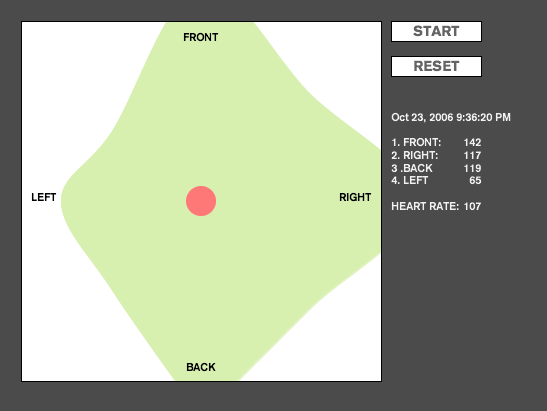
Urban Sonar- Kate Hartman
Kate Hartman’s projects generally make a playful commentary on how we interact with our environment. She often makes appendages to the body that are something between, clothing, toy electronic and sculpture. Although this project involves no actual appendages, it never the less visualizes a space that can be described as kind of appendage, our personal bubble. She collected data on her heart rate and the shape and size of her personal bubble. The results are displayed in the above visualization. (note: the image about is a still from the visualization, the actual program can be seen on http://www.urbansonar.com/visualizer.php). The circle in the center changes color depending on her heart rate as the green shape morphs depending on the dynamics of the space around.
I liked how this concept layers so much personality and narrative onto a simple performance and visualization.
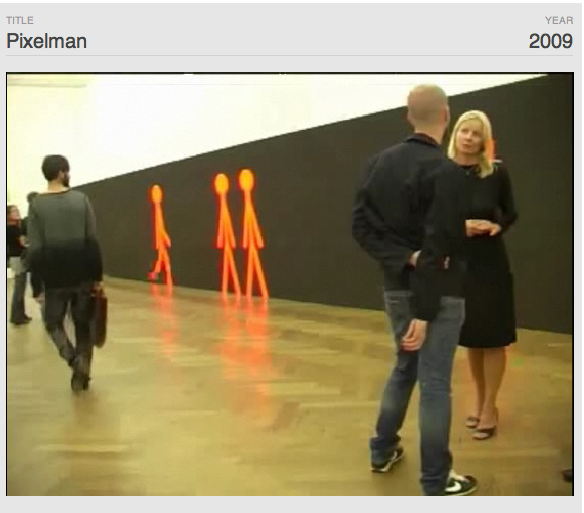
Pixelman- by Daniel Knorr programmed by Friedric Weiss
I was lead to this project through the work of Friedric Weiss. I was curious what other work he had been involved with because, I saw his work with Chunky Move. While involved with Chunky Move, he created interactive video projections that were then used in dance pieces. In the piece above, he aided the artist Daniel Knorr, in creating an interactive LED screen. Sensors detect the movement and presence of figures in a hall way and the LED screen reflects the presence of each figure with a simple orange stick figure. I like the way this installation takes dynamic data and simplifies it into a flat image.
Comments Off on Looking Outwards 2- Caroline Record